
Through the prosecutor's eyes
 Liberty County District Attorney Jennifer Bergman shares a brief overview of the various roles of her office during the first week of the Citizen Prosecutor Academy.
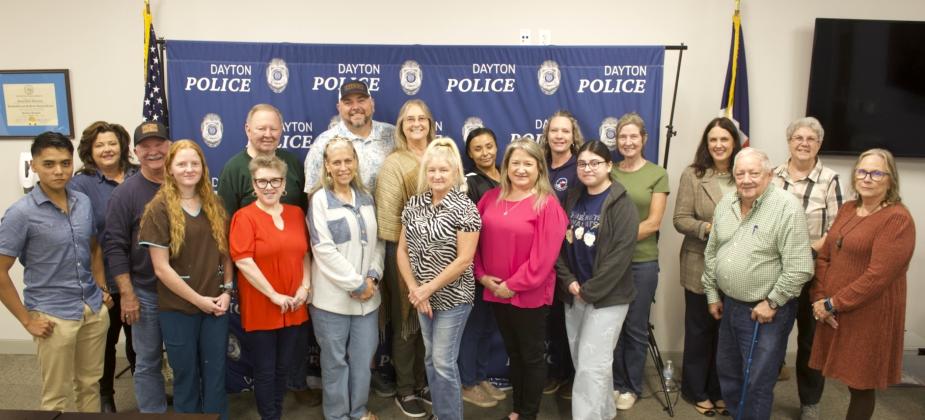 The Liberty County District Attorney's Office recently concluded its Citizen Prosecutor Academy, with 18 graduates gaining an in-depth understanding of the office's operations.
 Liberty County Fire Marshal Nathan Green shares a brief overview of the things his office handles during the final week of the Citizen Prosecutor Academy.
DAYTON— In a world where information is at our fingertips, people expect to know every detail of an incident or crime as soon as it happens. That simply isn't possible.
Recently, the Liberty County District Attorney's Office concluded its Citizen Prosecutor Academy, offering a unique perspective through the eyes of the prosecution.
Investigators must examine evidence and interview witnesses and victims, essentially piecing together a puzzle. Even then, prosecutors and law enforcement are prevented from giving all the details to protect the integrity of the case.
Even when all is said and done, when the jury returns a verdict and court is dismissed, we still may not have all the answers. Even the prosecutors rarely know the motive behind a crime.
The main takeaway from the class is that there is a lot behind the scenes that we will never see, but we did get a peek.
The Citizen Prosecutor Academy was held from Sept. 2 to Oct. 28, giving an in-depth class on what the DA's office deals with and why they do what they do.
Week 1: Overview, Oaths, On Call
The first week began with a general introduction, as prosecutors from the DA's office expressed that their main goal is to ensure justice is served, which may not always involve the maximum penalty.
Justice is ensuring the defendant has a fair trial and that the victims' families are taken care of.
"It's not just a job, it's a calling," District Attorney Jennifer Bergman said.
Prosecutors are held to different standards than defense attorneys, as they must provide probable cause and prove that the defendant committed the crime beyond a reasonable doubt, all while delivering timely disclosure of evidence before and during trials.
The defense is not burdened with the above, only having to disclose expert witnesses.
The office consists of seven prosecutors, five investigators, two victim assistance coordinators, nine support staff and five security officers.
First Assistant DA Anna Emmons said the staff are "critical" to the work they do.
There is always someone on call, rotating weekly, in case they are needed at a crime scene or need to write a search warrant.
Week 2: The Criminal Justice Process and Charging Decisions
The second week primarily consisted of discussions on search and arrest warrants, charging decisions, discovery and punishments.
Investigations are constantly ongoing, up until a jury reaches a verdict, and prosecutors work multiple cases at once.
Search warrants can be very particular, as law enforcement can only take what is mentioned. If something is found that isn't mentioned, an additional warrant must be approved.
Assistant DA Michelle Bush handles most of the intake for the office, acting as the bridge between law enforcement and the court.
Bush explained that every case has elements, or factors, and to be a case, each element must be present.
Elements include who, what, when, where and how. Using the game Clue as an example, Scarlett killed Professor Plum in the ballroom with a candlestick.
All felonies go before a grand jury unless waived by the defendant, and within 90 days of the arrest, the defendant must appear before the jury.
Prosecutors must turn over all evidence they find, including any information that may prove the defendant's innocence. The burden of proof, or the evidence required to establish the elements, is always on the state.
The DA's office primarily handles felonies.
State jail felonies are punishable for a maximum of 2 years, third-degree felonies have a range of 2-10 years, second-degree felonies have a range of 2-20 years and first-degree felonies have a range of 5-99 years.
Week 3: Family Violence, Vehicular Crimes
In family violence cases, prosecutors assume the victim will be uncooperative, whether it's due to love or fear, protecting the children, religion, or financial reliability.
ADA Kayla Hebert said about 80% of the time, the victim will stay with the defendant.
While most picture victims as quiet or timid women, victims can be anyone. Victims can be men or women, reserved or outgoing, tall or petite, etc.
If a victim wants to dismiss a domestic violence case, they are required to take an options course, where they learn about strategies to exit the relationship, signs of abuse and resources.
In these cases, evidence can be witness statements, 911 calls, medical records and jail calls. Photos can paint a picture, whether it's photos of the victim, holes in the walls, blood, or even just the home.
The class also heard about protective orders and lifetime protective orders, as well as vehicular crimes ranging from theft to DWIs to intoxicated manslaughter.
Week 4: Crimes Against Children
Liberty County Sheriff's Office Investigator Sean Mitchell discussed his role in investigating crimes involving children.
Mitchell explained that his primary role is to catch predators, using an undercover alias. His alias includes a photo of himself, photoshopped to appear as a 12-year-old girl.
Mitchell noted he ensures the suspect reaches out to him first to protect the case's integrity.
For child sexual assault cases, it can take years for victims to speak up for various reasons.
Investigations into CSA crimes include forensic interviews conducted by Bridgehaven Children's Advocacy Center or Sexual Assault Nurse Examiner exams.
Common myths were also discussed. Notably, DNA is not always present; oftentimes, there are no injuries, victims don't always hate or fear their abuser, mothers don't always protect their children, children don't usually lie about trauma and victims might not always show the expected emotion.
Week 5: Plea Negotiations, Trial Preparation, Anatomy of a Jury Trial, Appeals
For plea negotiations, the DA's office looks at the range of punishments.
A life sentence is 60 years, serving 30 years before being eligible for parole. Sometimes the DA's office will consider a plea of fewer years, often adding a clause that makes the defendant ineligible for parole.
Deferred adjudication is a plea agreement where, if the defendant violates a requirement, they must serve their entire sentence.
Deferred adjudication is sometimes needed to keep the court system moving, but that is not its primary use.
Pre-trial diversion is most often used for first-time offenders and is essentially an agreement that if the defendant does well, the case is dismissed.
Before making a plea agreement, prosecutors look at the offense, criminal history, potential issues with the case or witnesses, and the defendant's actions.
When preparing for trial, prosecutors meet with witnesses and victims, review and prepare evidence, and discuss strategy, which can include the order of witnesses or evidence that is presented.
There are two phases to trials: the guilt/innocence phase and the punishment phase.
Trial begins with voir dire, which is jury selection, followed by opening statements. The state always goes first during opening and calls witnesses first.
During trial, defense attorneys have the option to cross-examine witnesses, which the state can then redirect. Questioning can go back and forth between the state and defense until the witness is excused.
After both sides rest their cases, the judge reads the jury charge, which is followed by closing arguments. Once the jury makes a verdict, the punishment phase begins.
Week 6: Capital Murder vs Murder
Capital murder is defined by a few factors, including intentionally committing murder while attempting to commit another crime, killing a peace officer or firefighter in the line of duty, hiring/hired to kill someone, killing more than one person, or killing a child under the age of 15.
For sentencing, murder is 5-99 years or life, and capital murder is life without parole or the death penalty.
Death penalty cases are up to the district attorney to try, and many factors are considered, including offense, criminal history, personal background and more.
Emmons recounted four capital murder cases in detail from memory, sharing that she prosecuted each case and all four are currently sitting on death row.
"Those are the four I've tried. I'm okay with never trying another," Emmons said, explaining that it is emotionally difficult to ask a jury to sentence someone to death.
Week 7: Narcotics, Interdiction, Asset Forfeiture
For narcotics investigations, small crimes often help with investigations as they can lead investigators up the network chain.
The primary method for investigating narcotics is through informants, surveillance and search warrants. Law enforcement agencies throughout the country work together, whether local, state, or federal.
Most narcotics in Liberty County come from "source areas" such as Houston, Crosby and Channelview.
For the county, Illicit substances typically travel eastbound and northbound, while the money travels westbound and southbound.
Asset forfeiture is the seizure of money or things used or gained from criminal activity, such as vehicles, real estate and firearms.
Some items, such as modified firearms, are not allowed to be used and are typically destroyed once the evidence is no longer needed in court.
Forfeiture proceedings are similar to civil proceedings, and what is seized must be used to benefit law enforcement, most often used for gear or training.
Assets seized must be filed with the Texas Comptroller of Public Accounts.
Week 8: Public Integrity, Officer Involved Shootings
Liberty County has two Texas Rangers assigned to the area, with their primary job entailing officer-involved shootings, public integrity cases, and deaths of inmates while in custody.
Benson explained that sometimes the Rangers will assist with investigations in a supportive capacity.
For officer-involved shootings, Benson explained that law enforcement officials aren't trained to kill but instead are trained to neutralize or deescalate.
Benson referenced Tennessee v Garner, a 1985 Supreme Court case that ruled the Fourth Amendment prohibits law enforcement from using deadly force to prevent the escape or fleeing of a suspect or inmate, unless the person poses a serious threat to the officer or the public.
Emmons added that when an officer has to use a firearm, they are typically emotionally impacted by the incident.
Public integrity cases are "like a whole different beast unto themselves," Bergman said.
Texas Ranger Joshua Benson said he appreciated that Bergman wasn't afraid to pursue public integrity cases.
Benson said, "When one messes up...it erodes the trust" that people have with law enforcement.
Week 9: Law Enforcement Q&A
Law enforcement agencies from around the county came out for the final class, from Sheriff Bobby Rader to Fire Marshal Nathan Green.
Also in attendance were the Department of Public Safety troopers, Constable Precinct 5 David Hunter, Interim Dayton Police Chief Shane Burleigh, Cleveland Independent School District Police Department officers and more.
Green briefly discussed arson cases, noting investigating those is a primary function of his office in addition to inspecting businesses, schools and others.
"From fire to courtroom, the case is mine," Green said.
Hunter explained that the main role of a constable's office is to serve civil papers, such as eviction notices, and to serve as bailiff.
Burleigh discussed traffic in Dayton, sharing that his office is on track to hit 500 calls for wrecks this year. He did note that violent crime is at .02%.
Doug O'Quinn with Cleveland ISD talked about the school district, noting there are over 3,000 students just at the high school. He shared that CISD is looking towards bonds to build a second high school.
Graduation Ceremony
While the course was just a peek behind the scenes of the DA's office, it truly helps you gain a sense of understanding of why they do what they do.
Through the course, you learn what is required of them by law, you learn how much work goes into a case, and you learn that justice isn't always the harshest penalty.
"Hopefully, we have answered your questions, we have cleared things up, and given you the information and knowledge of what we do and why we do it," Emmons said.
During graduation, each student received a certificate and a challenge coin, and the students expressed a deep appreciation to the DA's office, not only for what they do, but for sharing it with us.