
Sylvia hosts annual hurricane gathering
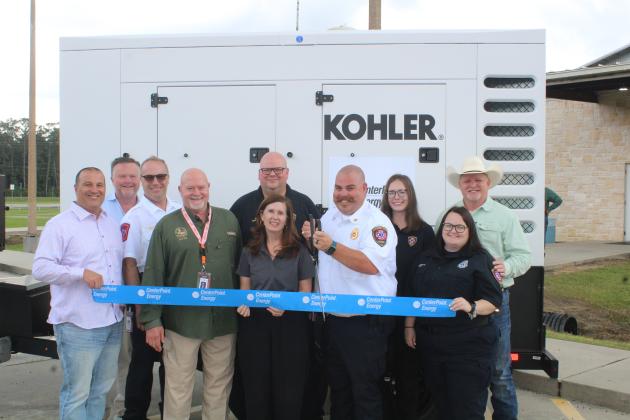 Chambers County Commissioner Pct. 4 Ryan Dagley (left), CenterPoint Director of Local Government Affairs Paul Lock, County Emergency Management Coordinator Ryan Holzaepfel, County Judge Jimmy Sylvia, County Field Operations Support Division Chief Quinten Adams, CenterPoint Director of Community Relations Alicia Dixon, County Deputy EMC and Safety Officer Jeffery Choate, County Emergency Services Support Specialist Haley Hernandez, County Emergency Services Administrative Assistant Sarah Phelps and County Commissioner Pct. 1 Jimmy Gore celebrate CenterPoint donating a generator to the county. CenterPoint's Community Generator Donation Program is part of the company's Greater Houston Resiliency Initiative. CenterPoint aims to donate 20 backup generators across its 12-county region.
WALLISVILLE— As hurricane season approaches, various organizations and community leaders came together to get to know one another in preparation for hurricane season.
The 16th Annual Chambers County Judge's Hurricane Workshop was held on Tuesday, June 3.
"While the skies are blue, you get to know the folks you need to know for when they're not," Judge Jimmy Sylvia said.
About 25 years ago, Sylvia began organizing county-wide meetings for school districts and county employees to get familiar with each other, discuss legislative changes and discuss things happening in the community.
Once Hurricane Ike hit in 2008, the annual meeting turned into a hurricane workshop.
Since taking on the role of county judge in 1997, Sylvia has collected decades of experience in natural disasters and emergency events, including Hurricanes Katrina, Rita, Humberto, Gustav, Ike, Harvey, Imelda, Laura, Beta and Beryl, along with the 2019 Atlas Air Crash, COVID-19, the 2021 winter storm and more.
Sylvia noted mayors and county judges serve as the top people in charge in cases of emergencies, bearing responsibility for how things are handled. If local responders are unable to manage a disaster, the state and sometimes the federal government will step in to assist.
Sylvia noted the importance of planning and practicing for emergencies before they happen.
Sylvia described various key factors in preparation, from details on the emergency operations center to shelters and staging areas for supplies, and the county has pre-disaster contracts in place.
Sylvia said communication is key. County emergency leaders have multiple daily meetings with key personnel, a phone station for questions from the community and various methods to relay information.
Representatives from various organizations- including Texas A&M Engineering Extension Service, National Weather Service, Texas General Land Office and Texas Division of Emergency Management- came out to share the resources they offer.
Katie Landry of NWS outlined conditions for this season and what to look for in the data. Hurricane season is typically from June 1 to Nov. 30, with the season at its peak in September.
The hurricane category primarily describes wind speeds, but there is more to look at to see the storm's impact, such as surges, rains and tornadoes.
Landry noted that about 90% of fatalities were water-related hazards, with storm surges causing 49% and rain causing 27% of storm-related fatalities from 1963 to 2012.
According to the National Oceanic and Atmospheric Administration, there is a 60% chance of an above normal season.
After the workshop, Sylvia said no matter what the prediction is, the county will be prepared.
"Even if it's only one a season, that could be the one that gets us," Sylvia said.
TEEX Training Manager Barry Graham and Training Specialist Nici English discussed the various training opportunities for first responders that they offer, including grant-funded courses.
Jet Hays of GLO discussed disaster recovery and how communities can rebuild, including the U.S. Department of Housing and Urban Development Disaster Recovery and Disaster Mitigation grants.
TDEM Preparedness and Response Chief Blake White explained that the purpose of the organization is to create a state emergency management program encompassing planning, training, response, recovery and more.
TDEM is broken into eight regions, and Chambers County is in Region 4, which has only 13 counties and is the second most populated region in Texas.
County Deputy Emergency Management Coordinator and Safety Officer Jeff Choate broke down the iStat and pStat programs, designed to self-report damage after disasters.
The programs operate the same, but iStat is for individuals and property owners, whereas pStat is for public buildings, such as public libraries and schools.
Documentation includes location, type of damage, insurance status, pictures and more, which is entered into the TDEM assessment dashboard.
Benefits of the programs include early awareness, speeding up disaster declaration, supports grant eligibility, and enhancing coordination between local government, TDEM and FEMA.
At the end of the meeting, Sylvia said he appreciated all the different organizations and governments that showed up, from federal to state to local. Sylvia noted that 12 to 15 counties were represented at the workshop, including four county judges.
To learn more about iStat, visit https://damage.tdem.texas.gov/.
To stay up to date on hurricane tracking, visit https://www.nhc.noaa.gov/. For weather updates in the area, visit https://www.weather.gov/hgx/.